

Quality over Cadence: Making Post-Trip Contact Meaningful


In short
Sending a welcome-home message is not the same as having a real plan for staying in touch after a trip. At the same time, sending messages for ninety days without a clear reason isn’t a plan either.
Passport Blueprint · Volume 1, Article 2 · Public article
Sending a welcome-home message is not the same as having a real plan for staying in touch after a trip. At the same time, sending messages for ninety days without a clear reason isn’t a plan either.
A couple returns from a long-awaited trip to Greece. The advisor sends a warm note, asks how everything went, and receives a generous reply. The couple had a wonderful time. In the same email, though, they mention that the airport transfer was confusing and that the final hotel was too far from the places they wanted to visit. The advisor thanks them for sharing and makes a mental note. Two months later, the couple receives a generic review request.

Nothing in that exchange is unfriendly. The problem is that it treats three separate tasks as if they’re all just about being nice. There was a service issue to fix, details to remember for next time, and maybe a public review to ask for. Each of these has its own purpose and timing. Mixing them up can make clients feel like they’re just part of a process, not truly understood.
Ideally, the advisor should have responded directly to the feedback about the transfer and hotel, confirming they heard the concerns and outlining any steps being taken, such as investigating the transfer issue or noting the hotel preference for the future. A timely follow-up to close the loop on these concerns shows the advisor is attentive and proactive, rather than simply moving forward with generic communication.
The first ninety days after a trip matter because the relationship shifts during that time. Right after the trip, memories are fresh. A few weeks later, clients might talk about it differently. Later on, the trip becomes part of the shared history between advisor and client. But this doesn’t mean you need to send messages for ninety days. Often, making two thoughtful contacts is enough, and it’s best to leave it at that.
Reader Poll
Choose one response to see where you land alongside other advisors.
The difference between an unresolved detail and a closed loop
In the first days after a client returns, it’s not about how many questions you ask. What matters is what you do with their answers. For example, if a couple says their transfer driver was forty minutes late, and no one explained why, just writing down “transfer issue” isn’t enough. A better record would include what happened, what was promised, who will follow up, and how the client wants to get updates.
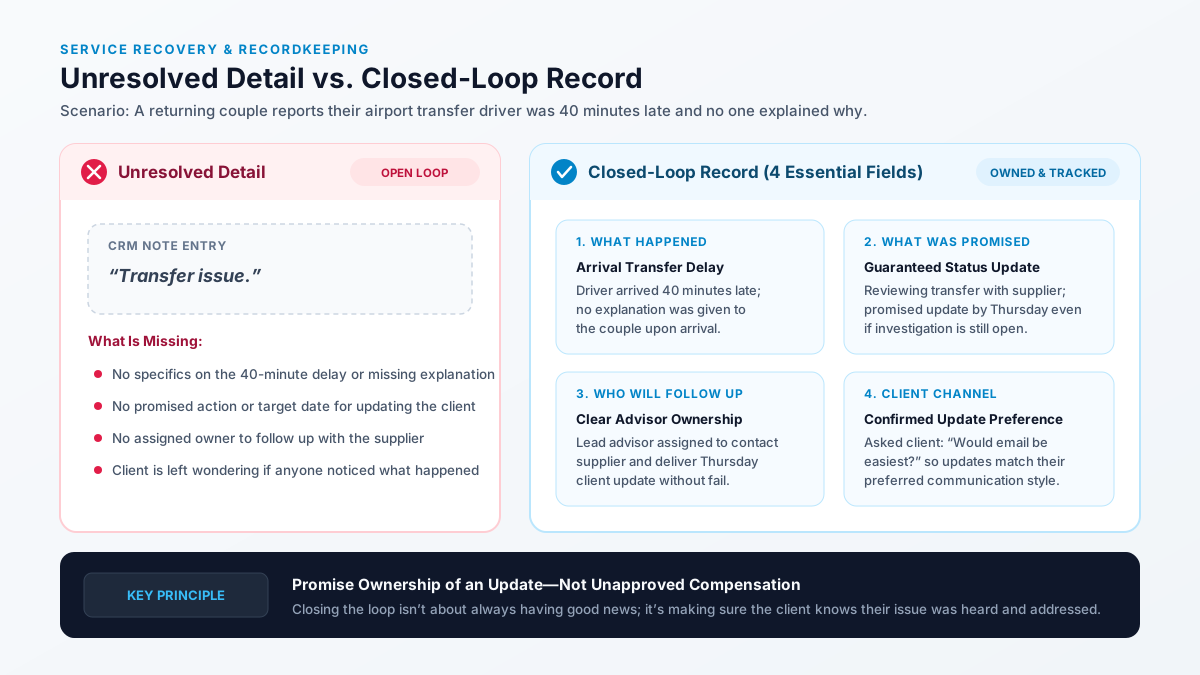
The advisor might write:
“I’m sorry the arrival was so uncertain. I’m reviewing the transfer with the supplier, and I’ll update you by Thursday, even if the investigation is still open. Would email be easiest?”
This statement does not promise compensation that has not been agreed. It does promise ownership of an update, which is something the advisor can control.
If a supplier takes longer to reply, the advisor still needs to send the promised update. Closing the loop isn’t about always having good news. It’s about making sure the client knows their issue was heard and addressed. Being honest about a tough situation can feel more respectful than sending a cheerful message that ignores the problem.
The earlier Passport Blueprint lesson, The Trip They’ll Remember, covers the debrief. This article picks up where that conversation stops. Here, we focus on what the client has already shared, not on creating extra interviews to fill up a calendar.
When a review request is appropriate
Asking for a public review is different from having a private conversation about service. A client might be happy to give honest feedback to the advisor but not want their trip or name shared publicly. Also, just because the advisor fixed a problem doesn’t mean the business deserves a positive review.
The timing of requests should depend on the relationship, not a set number of days. If a client is still waiting for an explanation about a problem, it’s not the right time to ask for a public review. Some clients may appreciate a neutral invitation to share their experience, as long as the request is honest, optional, follows platform rules, and isn’t only sent to those likely to give positive feedback.
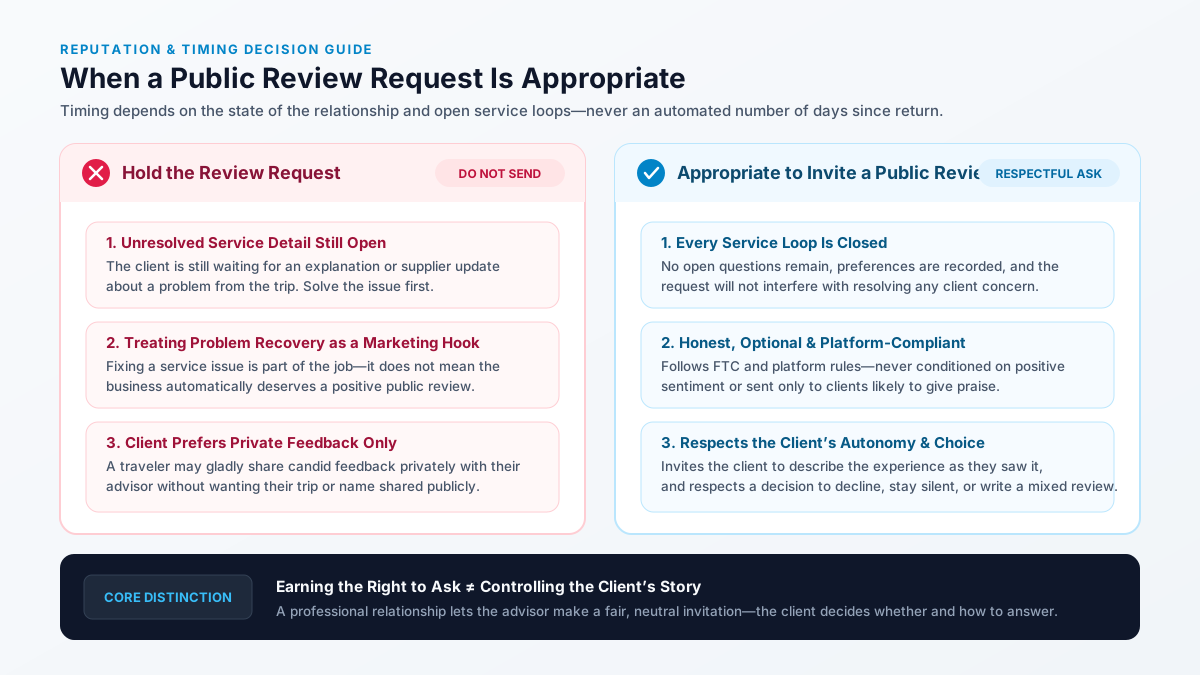
Consider a more respectful request:
“I appreciate what you shared about the trip. If you would be comfortable describing your experience publicly, a review would help other travelers understand how we work. No pressure, and please describe the experience as you saw it.”
The client can decline, remain silent, or write a mixed review. The advisor’s obligation is to respect that choice.
It’s important to know the difference between earning the right to ask and expecting to get the answer you want. A professional relationship lets the advisor make a fair request, but it doesn’t mean they control the client’s story.
What to do when there is nothing to ask for

Some post-trip routines treat clients like marketing leads as soon as they get home: there’s a thank-you note, a review request, a referral request, destination ideas, and then a prompt to book another trip. Even if the messages sound friendly, the overall effect can feel impersonal, as these communications primarily serve the agency’s interests rather than respecting the client’s preferences or readiness for further engagement. When every message asks the client to do something for the business, it can undermine client autonomy by prioritizing the agency’s agenda over the client’s desire to control the pace and nature of post-trip contact.
Relationships also grow from messages that don’t ask for anything. This could be a helpful update from a supplier after the trip, a reminder about a needed document, or a thoughtful note about a family milestone the client mentioned. Sometimes, it’s best not to send any message until there’s a real reason.
Silence doesn’t always mean neglect. If a traveler wants to start future travel talks themselves, respecting that is good service. If a family still has an unresolved issue, the next message should focus on that. And if a client has already given a review, there’s no need to ask again just because it’s part of a campaign.
A practical ninety-day decision framework
The specific day matters less than the work itself. Think of three phases as checkpoints to review, not as fixed dates for sending messages.
Early: repair and record. Make sure any promised solutions are finished, note important preferences and frustrations in the client’s record, and check that the advisor hasn’t created a next-trip request without reason. If needed, give the client a clear update schedule. If everything is resolved, no extra contact is needed.
Middle: reputation, when it fits. Decide if it’s the right time to invite a public review, and make sure it won’t get in the way of fixing any open issues. Not every client should be asked for a review, and don't use fixing a problem as a marketing opportunity.
Later: settle and anchor. Figure out what should last beyond the first weeks after the trip—like a preference that could shape plans, an issue that shouldn’t happen again, a future idea that needs the client’s approval, or a clear choice for the client to reach out first. If these details are already in the record, you may not need to send another message.
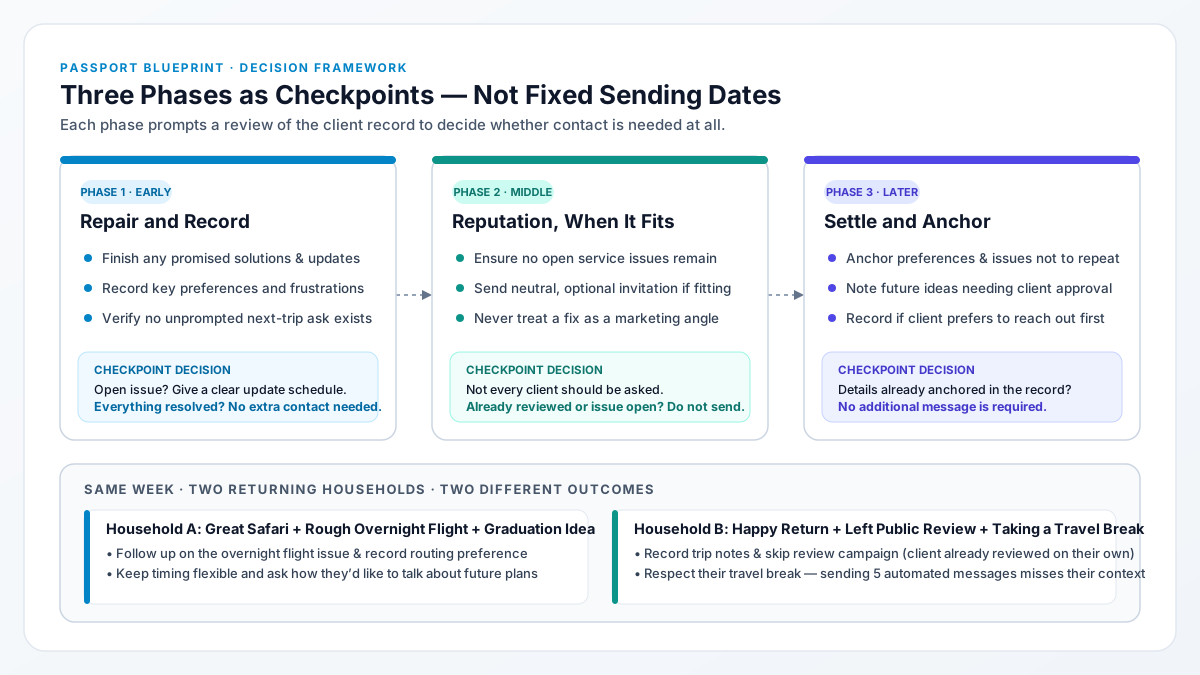
Picture two households in the same week. One sends a detailed note about a great safari, a rough overnight flight, and maybe traveling again after a graduation. The advisor might need to check on the flight issue, keep the timing flexible, and ask how they’d like to talk about future plans. The other household says they were happy, leaves a public review on their own, and mentions they’re taking a travel break. Sending the same five messages to both isn’t real consistency—it’s missing what makes each situation unique.

The question behind the calendar date
Suppose a team sets up three post-trip tasks: a debrief at day seven, a review request at day twenty-one, and a check-in at day ninety. The list looks organized and might even boost the team’s sense of progress. But what if the debrief uncovers a big problem that isn’t fixed by day twenty-one? Does the review request still go out? And if the client wants to reach out on their own, does the day-ninety check-in feel helpful or intrusive?
A good workflow should answer these questions before anything is automated. Dates should remind the team to review decisions, not make choices for them. The real reason to reach out should be based on what the client actually needs. For example, “Issue awaiting supplier response; advisor will update Friday” is a reason. “Twenty-one days since return” isn’t enough by itself.
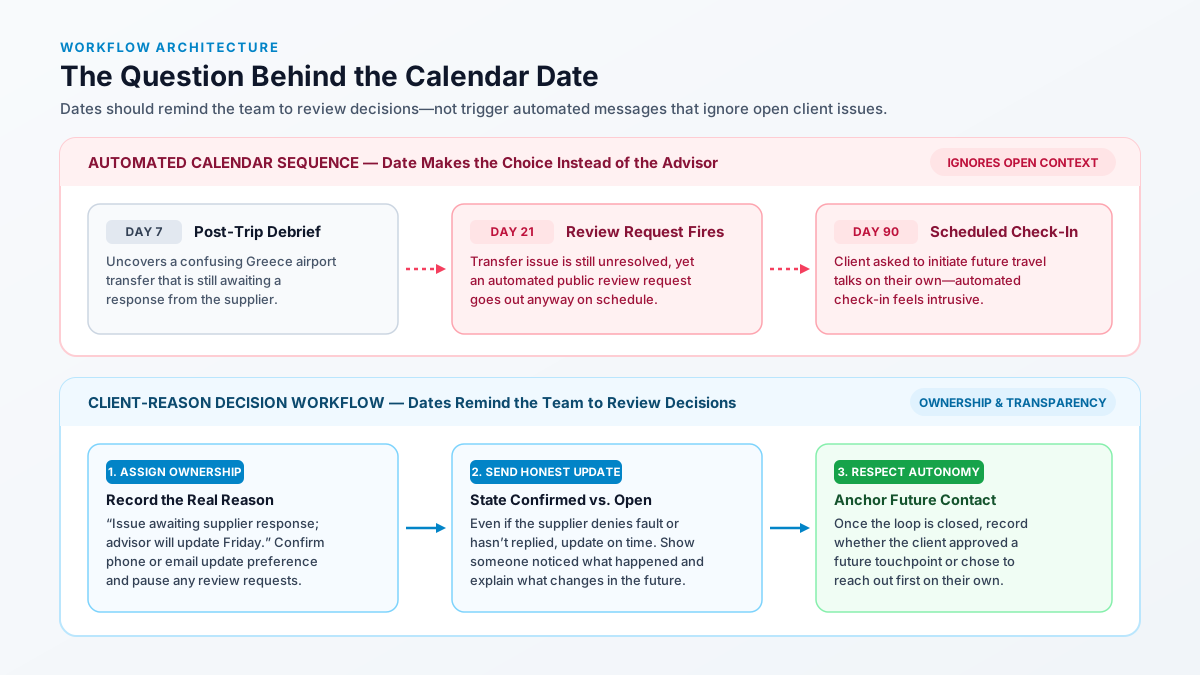
Think back to the Greece clients from earlier. When they mention a confusing transfer, the advisor faces at least three priorities. It’s fine to thank them for bringing it up or to ask if they’d rather get updates by phone or email. But these steps don’t replace actually finding out what happened and explaining what can be done. If the agency already has an answer from the transfer provider, the next message should make clear what’s confirmed and what’s still in question. If there’s no reply yet, the advisor should say so and give a specific time for the next update. Promising to “look into it” without saying who’s responsible is just an unfinished step, not a real solution.
Now imagine the supplier says it’s not their fault. The advisor might want to drop the subject because the next message could be awkward. But the client’s real question might not be “Can you get us compensation?” It could be “Did anyone notice what happened to us?” An honest reply that explains what the agency can and can’t do, and what will change in the future, can be more respectful than saying nothing. Don’t make up a solution, and don’t present the supplier’s view as if it’s the only true version of what happened to the client.
Three households, three different ninety-day records
A family comes back from a complicated trip and reports a service problem. Their next-contact record lists the unresolved issue, who’s responsible, and when they’ll get an update. Requests for reviews are put on hold. There might not be any talk about future trips until the problem is sorted out.
A couple comes back from a great anniversary trip, sends detailed photos, and a warm thank-you. They say they’re open to a review request and have already agreed to reach out to the advisor when they’re ready for another trip. The record should show one review invitation, then let the clients take the lead. There’s no need to schedule extra check-ins just to show how you care.
Another household prefers minimal communication but mentions their adult child will graduate in eighteen months. The advisor can ask if the family wants a reminder before planning starts. If they say yes, that’s a clear, client-approved future contact. If not, the milestone is just context, not a reason to start planning.
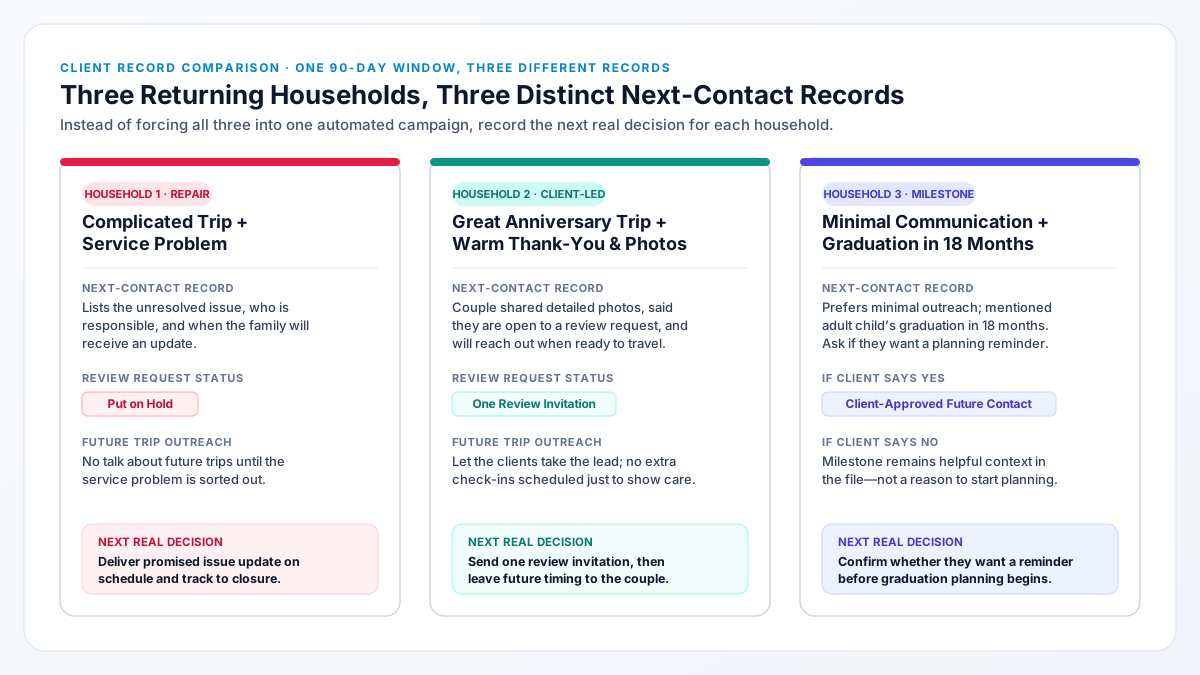
From the agency’s perspective, a ninety-day sequence might seem like one process, but it’s actually three different situations. Treating them all as exceptions to a single campaign can create extra work. It’s easier to start by recording the next real decision for each client.
A useful quality review

During a quarterly review, look at some contacts who got automated follow-ups and some who didn’t. Read the actual messages, not just the numbers. Was each message tied to a real client reason? Did anyone acknowledge unresolved service issues? Were promises given to someone to handle? Did the client approve research before supplier work started? Were client preferences respected? These are things a manager and advisor can talk about, without claiming the sample proves anything about retention.
For a simple review, use a checklist like this:
- Did each message have a clear purpose related to the client?
- Were all service issues acknowledged and tracked to closure?
- Was ownership for follow-ups or promised actions clearly assigned?
- Were requests for reviews or referrals made at appropriate times?
- Are client preferences and next steps recorded in the client file?
- Did the client agree to the next contact, or are they waiting to initiate?
This list makes it easier for advisors to review their recent work and identify where small changes can make a real difference.
You might find that the team’s review requests are thoughtful but sent at the wrong time, or that every service issue has an owner but there’s no reliable way to check if it’s closed. Fix these problems before adding more follow-ups. The first ninety days aren’t about how often you contact clients, but whether you keep the promises made during the trip.
The ninety-day audit that takes less time than a campaign
An agency owner can check a small sample of returning households without starting another reporting routine. Pick ten households that came back at least three months ago. For each one, see if any problems were closed or handed off with a clear owner, if travel preferences were recorded, if review requests fit the situation, and if future contact plans match what the client wants.
This is a quality check, not a count of how many messages were sent. A household with no marketing messages might have gotten great service. Another with six automated messages could still be waiting for an answer about a missed transfer.
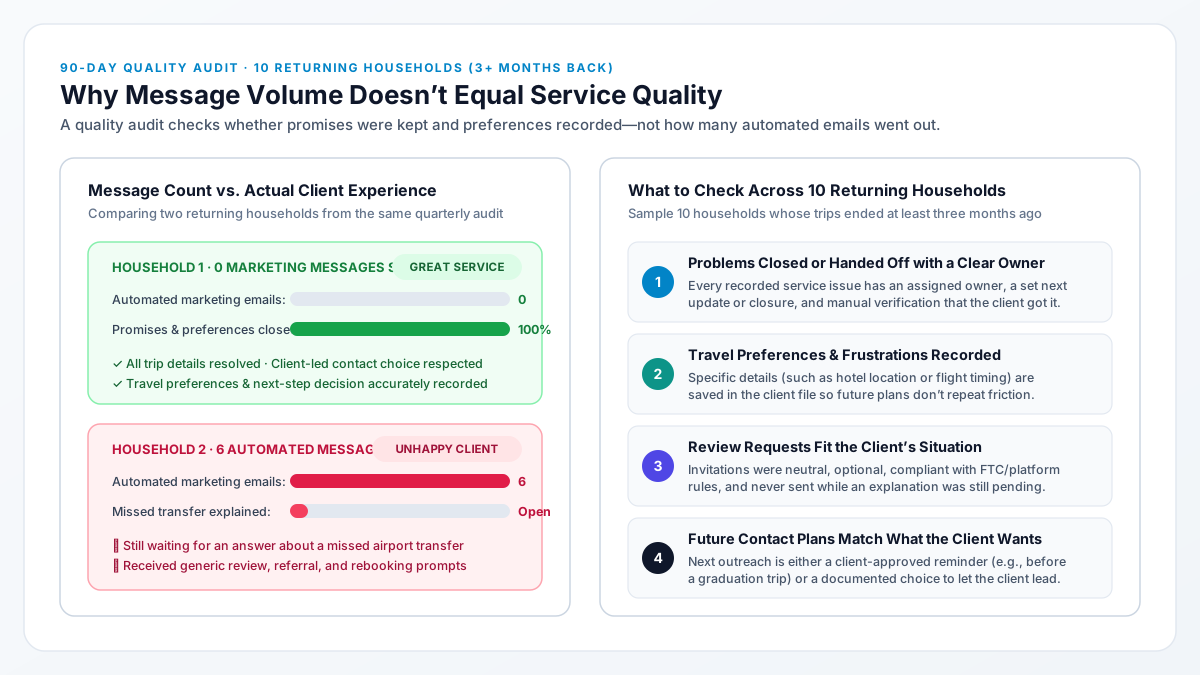
If you want a simple way to measure, look at how many recorded service issues have a clear owner and a set next update or closure. Also, do a quick manual check to see if clients actually got what was promised. Just counting closures without checking the real experience can lead to a neat dashboard but unhappy clients.
The ninety-day window should not function as a performative measure of attentiveness but rather as a strategic opportunity for cultivating meaningful client relationships. By deliberately reflecting on lessons learned, fulfilling outstanding commitments, and prioritizing client preferences, advisors can foster trust and long-term loyalty. In practice, upholding discreet but reliable promises has a more substantial and enduring impact on client engagement than relying on unnecessary or generic communications. This approach underscores the importance of intention and responsiveness over frequency, guiding future service models toward practices that are both ethical and client-centered.
Editorial reference for review requests: U.S. Federal Trade Commission, Consumer Reviews and Testimonials Rule, Questions and Answers (https://www.ftc.gov/business-guidance/resources/consumer-reviews-testimonials-rule-questions-answers). Do not condition or selectively solicit reviews based on expected positive sentiment. Advisors should also check for additional local laws and compliance rules, as well as platform-specific or review site guidelines, since requirements may differ across regions and partners. This helps ensure full compliance and builds client trust.
- retention
- passport-blueprint
- post-trip-follow-up
- reviews
- client-relationships